Ioana Adina Marin — a professional video portrait about trust
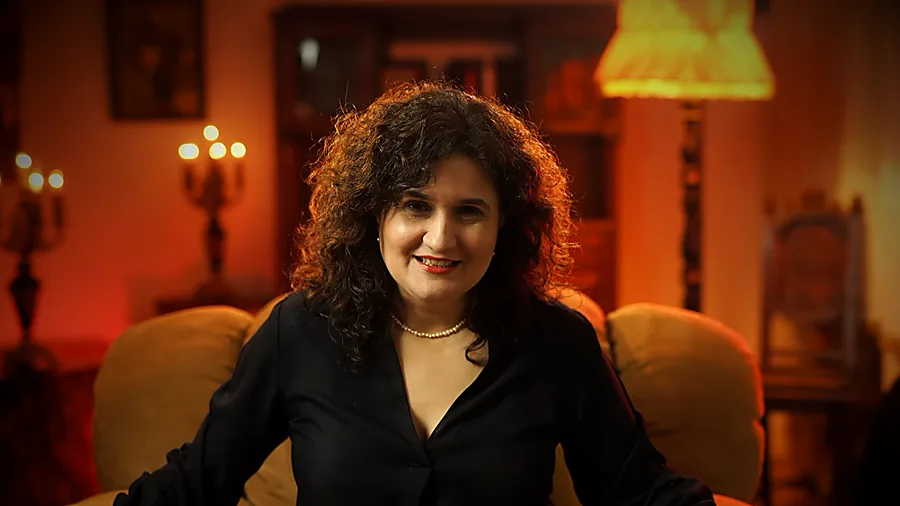
Professional video portrait / professional services
A professional video portrait built around listening, trust and the human relationship behind a profession in which people look for clarity before making a decision.
About Ioana Adina Marin’s professional video portrait
Ioana Adina Marin is presented as a lawyer and mediator in a film that shifts the focus away from abstract descriptions of the profession and towards the way a professional communicates and builds trust.
The interview and imagery are used to reveal the person behind the professional service, in a format suited to online presentation and personal-brand communication.
The project shows how a professional video portrait can humanise a serious profession without turning it into artificial advertising.
Ioana Adina Marin works in two distinct professional roles. Information about her work as a lawyer is presented on the page Ioana Adina Marin — lawyer in Bucharest, while her mediation work is presented separately on Ioana Adina Marin — mediator in Bucharest.
- Location
- Ioana’s office.
- Year
- 2023.
- Filming
- Two days.
- Lighting
- Almost an entire day spent on lighting preparation alone.
- Interview
- Prepared structure, many takes and direct-to-camera practice.
Sometimes a video portrait begins before you turn on the camera.
The idea for the film was mine. I wanted Ioana to feel more approachable in the way she spoke and presented herself to people who might work with her. We filmed in her office, but the office did not simply stay as I found it. I rearranged it substantially for the camera.
Almost an entire day went into the lighting alone. I used many light sources and changed things that seemed unimportant to the naked eye. A camera has the annoying habit of turning one small overlooked object into the only thing you can see afterwards. Sometimes you fix it, look again, and then fix something else.
Looking directly into the lens is something you learn too.
The interview had a prepared structure, but we filmed many takes. I worked extensively with Ioana on speaking directly into the lens. I even recorded “this is how not to do it” demonstrations so she could see the difference clearly. The point was not to make her play a role, but to find a form in which the camera no longer stood between her and the person listening.
What I liked were the small gestures, the things that cannot be written into a script. Because of them, I did not want a conventional law-office promotional spot. I wanted something closer to a story about a person, keeping the profession very clear without allowing the profession to swallow the person.
The camera did not need to make Ioana more convincing. It needed to disappear from between us.
I think one of the hardest things when filming a professional is the temptation to make them speak “well for the camera”. That can be exactly where the problem begins.
With Ioana we did many takes and worked extensively on direct eye contact with the lens. Not because she did not know what she wanted to say. Quite the opposite. The challenge was to reach a point where the information stayed clear but the person no longer looked as though she was reciting for a device sitting one metre in front of her.
That is why I also made “this is how not to do it” demonstrations. Sometimes it is much easier to see the difference than to have someone explain it to you.
For me, the good moment is not necessarily the one in which the sentence comes out perfectly. It is the moment when you stop noticing the camera and start listening to the person in front of it.
And this is exactly where Ioana’s film confirmed something I had learned over years of filming: in a professional video portrait, a small imperfection can be more valuable than a perfectly delivered sentence. If you cut every breath, every hesitation and every gesture that does not look “perfect”, you risk being left with the profession while losing the person.
I wanted exactly the opposite: the profession to remain completely clear, but Ioana to remain there too.
And editing also meant cutting.
One of the important decisions was the length. I shortened the film. During the same two days we filmed both the main portrait and separate, more utilitarian material for the legal side of her work. The fact that we filmed them together did not mean they had to become the same kind of film.
“I didn’t want a film in which I looked as though I was reciting something for the camera, nor did I want a conventional law-office promotional video. Mugur and I worked extensively on the framing, the lighting and, above all, the way I spoke directly to the camera. We did many takes — including a few ‘this is how not to do it’ demonstrations :)) — until the information remained clear but the delivery felt natural. In the end, the film does not try to make me look like someone else. I recognise myself in it. To me, that means it did its job.”