Ion Mândrescu — the sculptor who conquered Paris
Documentary portrait / art
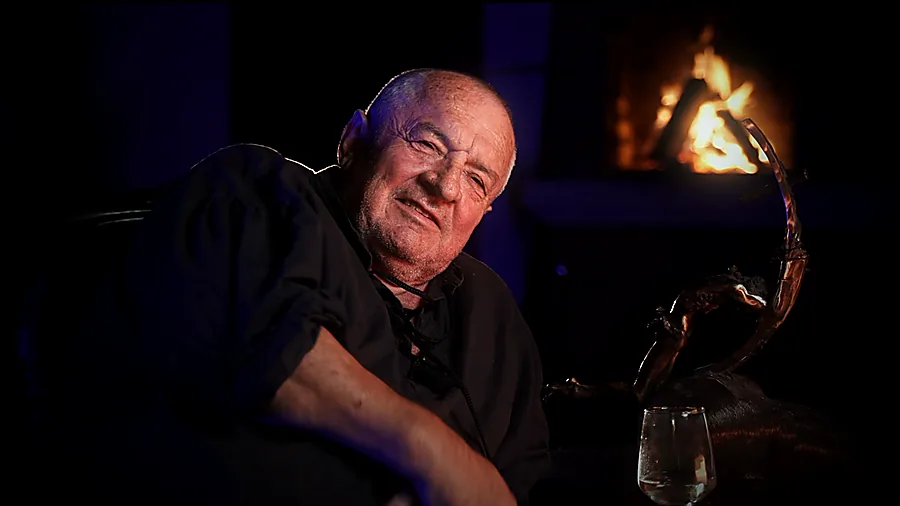
A documentary portrait of sculptor Ion Mândrescu, built around art, bronze, time, space and memory.
About the Ion Mândrescu documentary
The film follows Ion Mândrescu both as an artist and as a person, using the studio, sculpture, material and his own words as parts of the same story.
Instead of a quick presentation, the project leaves room for atmosphere and for the relationship between the artist, time and the objects he creates.
The project shows how an author-driven film can build meaning through interview, space, detail and rhythm without reducing its subject to a simple promotional message.
- Relationship
- We have known each other for around 20 years.
- Main shoot
- Summer 2024, Mihoveni, during one main day of filming.
- Cameras
- 2 × Sony A7 III + Sony NX80 for the long perspective.
- Sound
- Two lavalier microphones, a shotgun microphone and two separate recorders.
- Material
- More than approximately 1 TB accumulated over time.
- Editing
- Around one year of work; the final film is 44 minutes long.
Sometimes a film begins before you know you are making one.
I have known Ion for around 20 years. We met through mutual friends, in his studio. My first clear memory is not solemn in the slightest: Ion was making a barbecue. :)) Over time I came to understand how authentic he is as a person, and at some point I felt very clearly that I wanted to be the one to film him. It was not a client commission. It was more like an internal need, a fire that would not leave me alone.
Part of the film, however, existed long before the 2024 interview. Around 15 years ago we were at the seaside and I had only my phone with me. Ion had brought an entire barrel of clay and started making heads roughly two-thirds life-size, each with a different, very powerful expression. Video control on phones was rudimentary then. I remember struggling to install whatever “pro” apps existed at the time just so I could lock exposure and white balance. Today that sounds trivial. Back then it was not.
Three cameras, a fire behind him and a yard full of cables.
The main shoot in Mihoveni in the summer of 2024 was filmed with three cameras: two Sony A7 III bodies and a Sony NX80 for the long angle. I used 50 mm and 35 mm lenses, and placed the fire behind Ion. The lights had to work through trees and bushes. The yard was full of cables, with one important condition: none of them could appear in the frame.
For sound I used two lavalier microphones, a shotgun microphone and two separate recorders. In the end, the interview became the best surprise. Ion genuinely wanted to talk. It turned out far stronger than I expected and became the backbone of the film.
The most technically challenging footage came from the exhibition opening in Sibiu. It was raining, it was very dark, and the Panasonic camera I was using at the time was not particularly strong in low light. I had a great deal of denoising work to do later. It is not the romantic side of documentary filmmaking, but it is exactly the kind of thing that decides whether a shot survives in the film or not.
“Every material has its own language.”
The camera has its language. The microphone has its own. So does light.
Ion’s idea about materials stayed with me. Clay, earth, stone and metal do not ask for the same thing. My tools do not speak in the same way either. The camera says something through distance and angle, the microphone through proximity, and light through what it reveals or leaves in shadow.
There are things in the studio that you would never notice in a conventional presentation photograph: a plaster femur, a torso, a small unfinished wax hand left in a corner. For me, those details are precisely what make the space real. Many of the works connect to “Man, Time, Space”, but I did not want to invent labels for every object. Sometimes it is better simply to let Ion talk about them.
A film is also what you choose not to use.
There were things I deliberately chose not to include in the edit. Not because they were uninteresting, but because taken out of context they could have invited unkind comments that had nothing to do with the wonderful person I was trying to show. Editing is not only about finding what is good. Sometimes it is about protecting meaning.
Altogether, the project involved around a year of work and more than 1 TB of material, including older footage. The final film is 44 minutes long. And I still film Ion whenever something appears that deserves to be preserved.
Friend or mentor? It depends when you catch him.
Ion is both my friend and my mentor. I do not separate the two roles very well. I do not think he does either. Somehow he decides for himself when he is one and when he is the other. That is one of his superpowers. :))
The Ion Mândrescu Documentary in a Museum Context
On 16 October 2026, the documentary portrait of sculptor Ion Mândrescu formed the basis of a presentation included in the official programme of the 10th National Conference “Heritage and Education in Art Museums”, organised by the “Gavrilă Simion” Eco-Museum Research Institute (ICEM Tulcea).
The presentation, entitled “Documentary Film as a Tool for Preserving the Memory of a Contemporary Artist — Ion Mândrescu: The Artist, the Studio and the Creative Process”, was delivered indirectly through a PowerPoint presentation projected and commented on at Casa Avramide.
During a break in the conference, the audience watched the complete documentary portrait, approximately 44 minutes long.
The presentation explored the documentary film’s capacity to preserve the artist’s voice, working gestures, studio environment and the context in which artworks are created.
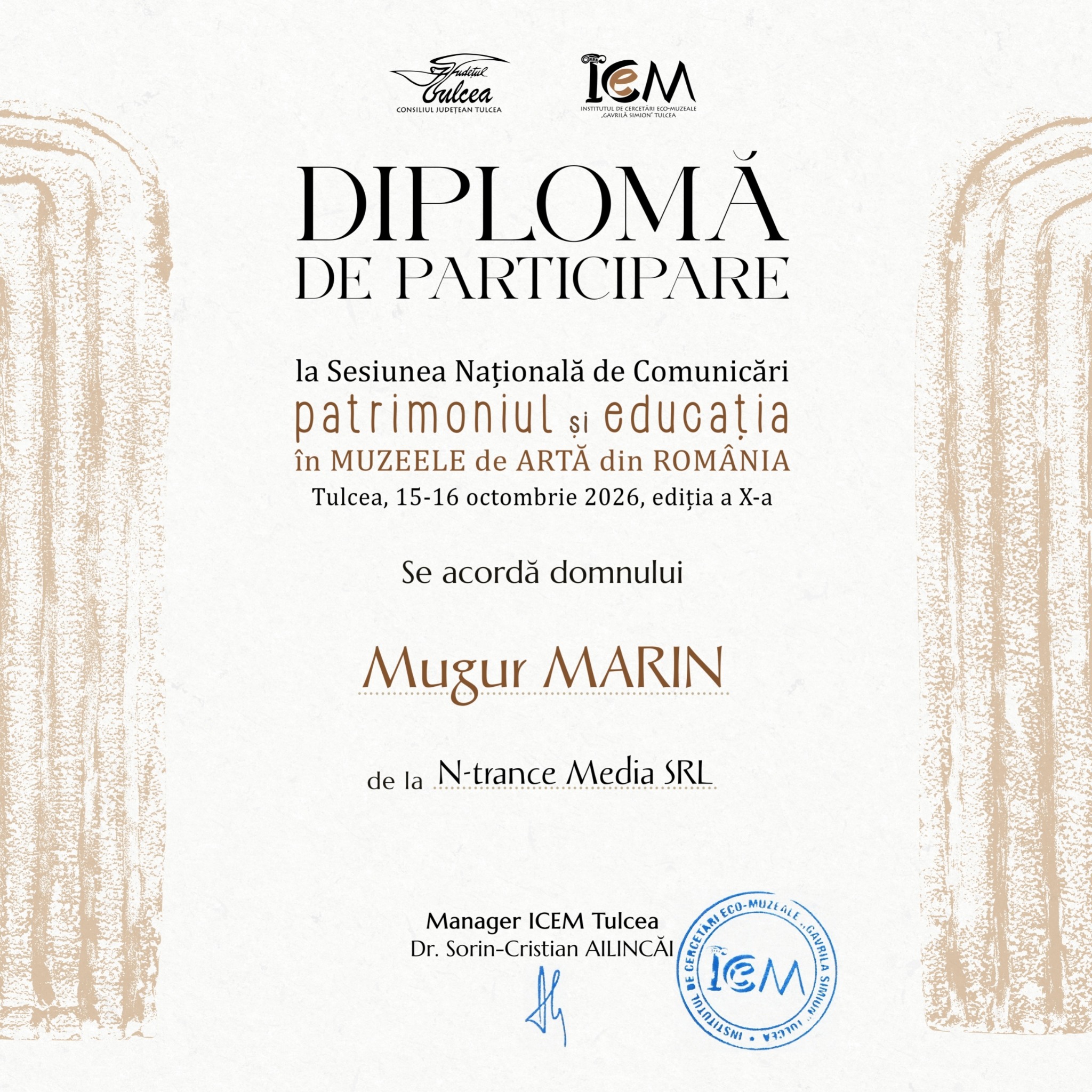
The participation of filmmaker Mugur Marin / N-trance Media SRL was confirmed by an official certificate issued by the organising institution.
The Tulcea Presentation — Video Recording
The following recording, approximately 6 minutes and 52 seconds long, brings together the PowerPoint presentation discussed at the conference, the introduction to the documentary screening and the comments made after the audience had watched the film.
Footage source: Museum of Art and Casa Avramide, Tulcea / ICEM “Gavrilă Simion”. Selection and editing of the excerpts: Mugur Marin / N-trance Media.
Certificate of Participation — Tulcea, 2026
Certificate awarded to Mugur Marin, representing N-trance Media SRL, for participating in the 10th National Conference “Heritage and Education in Art Museums”, held in Tulcea on 15–16 October 2026.